

Renting a flat, a commercial unit or a warehouse without landlord and tenant being in the same office is now commonplace: one lives in another city, the other signs from work, the agency handles several deals at once. The question is whether a rental contract signed on a phone is worth the same as a paper one. In general, yes. But there are nuances worth knowing before you send it out for signing.
What the law says about the form of a rental contract
The Ley 29/1994, de Arrendamientos Urbanos (LAU) (Spain's Urban Leases Act) deals with the form of the contract in Article 37. In the wording in force at the date of this post:
- Either party may require the other to put the contract in writing. In that case, it must state the identity of the contracting parties, the identification of the property, the agreed term, the initial rent and any other clauses they agree.
- If the tenant requests it, putting the contract in writing is mandatory. Even so, failing to do so does not affect the validity of a contract made verbally, without prejudice to any administrative liability that may arise under sector-specific legislation.
This article has been amended by Real Decreto-ley 29/2026, de 6 de octubre, de medidas urgentes en materia de vivienda (a Spanish royal decree-law on urgent housing measures). Royal decree-laws must be ratified by the Congress of Deputies, so if you are going to rely on this point, check the consolidated text in force on the day you sign in the BOE (Spain's Official State Gazette).
What matters here: the law asks for a written contract when one is requested, not a paper contract.
Why an e-signature is valid for a lease
Regulation (EU) 910/2014 (eIDAS) establishes in Article 25(1) that an electronic signature cannot be denied legal effect or admissibility as evidence solely because it is electronic. Ley 6/2020 (Spain's law on electronic trust services), in Article 3, gives private electronic documents the value appropriate to their nature. A lease is a private document, so when signed electronically it is still a valid written contract.
What changes with an e-signature is not validity, but how you show who signed and that the text has not been altered. So rather than asking whether it is "valid", ask whether you will be able to prove it if there is ever a dispute.
When a private signature is not enough
There are cases where a private contract, whether signed on paper or electronically, is not sufficient:
- Registration in the Land Registry. Article 1280 of the Código Civil (Spanish Civil Code) requires a public document for leases of real estate of six years or more where they are to affect third parties. If you want the lease to be enforceable against a future buyer, for example, speak to your notary.
- Representation. If someone signs on behalf of the owner or of a company, check that they have sufficient authority and keep a copy of that power of attorney with the contract.
- Regional formalities. The deposit of the security deposit and other formalities depend on each autonomous community. Check which contract format they accept in your case.
How to prepare the contract for remote signing
- Check the parties' details. Name, DNI or NIF (Spanish ID or tax number), address and, for a company, who represents it.
- Identify the property properly. Full address, cadastral reference if you have it, and annexes (garage, storage room).
- Attach the annexes to the same document. Inventory of furniture, condition of the property, energy certificate: if they are inside the signed document, there will be no doubt about what was handed over.
- Define who signs. Landlord, tenant and, if there are any, guarantors or co-holders. All on the same document.
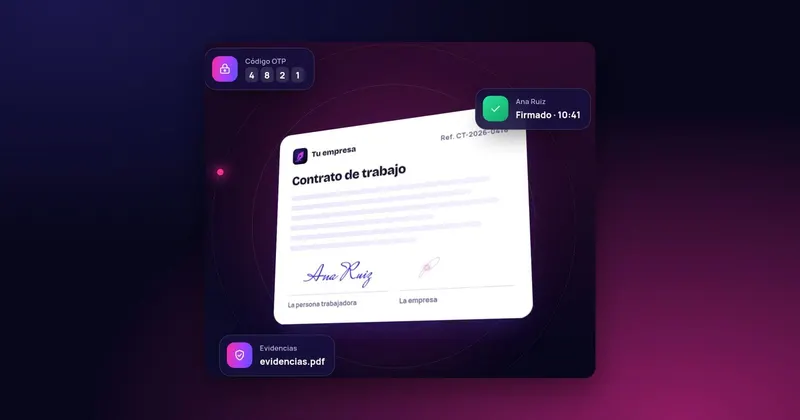
- Verify the identity of each signatory before signing, for example with an SMS code sent to their mobile.
- Send it and track its status. Check who has signed and who needs a reminder.
- Give a copy to all parties and keep the signed original together with its audit trail.
Typical situations and how to handle them
| Situation | How the e-signature fits |
|---|---|
| Tenant living in another city | Signs from their phone before collecting the keys |
| Two tenants and a guarantor | All three sign the same contract, each from wherever they are |
| Renewal or rent update | An annex referring to the original contract is signed |
| Lease of a commercial unit or warehouse to a company | The representative signs; keep their power of attorney with the contract |
| Notice of end of contract | Sent as a notification with proof of receipt |
Common mistakes
- Signing one version and giving the tenant a different one.
- Leaving out the annexes and signing them separately later, with no clear link to the contract.
- Not checking that the person signing for a company has authority to do so.
- Thinking an e-signature replaces a public deed when the lease needs to be registered.
- Giving notice of the end of the contract by a simple message, with no proof of receipt.
Rental contracts with InfoSign
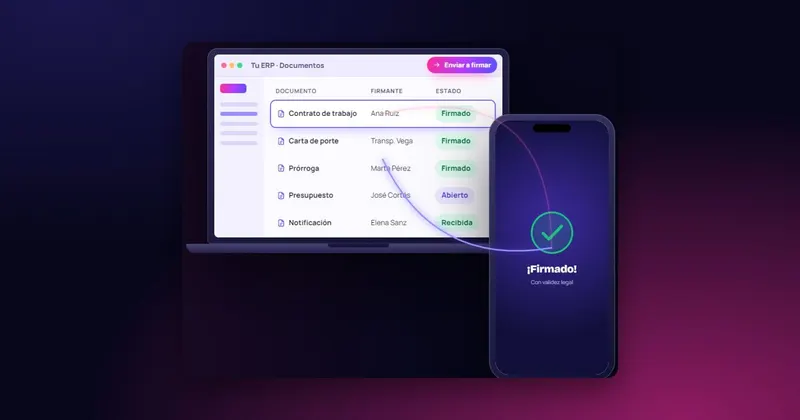
Leases and sales contracts are among the documents you can sign with InfoSign. The contract comes out of your management software, each party signs from their mobile, tablet or computer without installing anything, and several people can sign the same document. You can add OTP verification by SMS and follow the process in real time, with reminders.
Once everyone has signed, you receive the contract and its evidence document, with the document's digital fingerprint and the date and time of each step. And if you later need to give notice of a renewal or the end of the contract, you can do so with a certified notification with proof of receipt. More details at e-signature of documents.
 Test agreement