
Some communications are not enough just to send: you have to be able to prove that they arrived, when, and with what content. A notice period, a payment demand, a letter to an employee, the notice that a contract is ending. For years the answer has been the burofax (a certified postal service in Spain) or a registered letter with acknowledgement of receipt. Today there is the certified electronic notification, which arrives instantly and leaves its own proof. This article compares the two options and helps you choose in each case.
What a burofax proves and what it doesn't
The burofax is a postal delivery in which the operator certifies the text sent and, if you pay for it, the delivery. Its strengths are well known: it is a long-established method and its proof is issued by a third party. Its weaknesses are well known too:
- You have to prepare the text, go to a post office or use an online service, and pay for each item sent.
- It is slow: between dispatch, delivery and delivery attempts, days can go by.
- If the recipient is not in or does not collect it, the item may be returned undelivered.
- The proof arrives later and on paper, and you have to file it with the rest of the case file.
What a certified electronic notification is
It is the sending of a document by electronic means with a record of every step: when it was sent, when it was opened and, if requested, when the recipient confirmed receipt or signed. Regulation (EU) 910/2014 (eIDAS) governs these services under the name "electronic registered delivery". Article 43 establishes that data sent and received using this service shall not be denied legal effect or admissibility as evidence solely on the grounds that it is in electronic form or that it does not meet the requirements of the qualified service.
As with e-signatures, there is a qualified level (provided by a provider listed on the trusted list) with strengthened legal presumptions as to integrity, the sender, the recipient and the date and time. The non-qualified level is valid as evidence and can be defended with the process's evidence log.
Quick comparison
| Aspect | Burofax | Certified electronic notification |
|---|---|---|
| Time until it arrives | Days | Instant |
| Travel and paper | Yes | No |
| Cost per item sent | Each item is paid for separately | Depends on the service contracted |
| Proof of content | Certification of the text by the operator | Digital fingerprint of the document sent |
| Proof of delivery | Postal acknowledgement, if contracted | Opening log and acknowledgement of receipt |
| If the recipient doesn't respond | Notice of arrival and return | You can see it hasn't been opened and send a reminder |
| Filing | Paper that has to be kept | Digital, alongside the case file |
When each option is best
Electronic notification works very well when you already have a relationship with the recipient and a contact channel that they have given you themselves: your employees, your regular customers, your suppliers. For example:
- Communications to staff: shift changes, notices of the end of a temporary contract, meeting calls or delivery of documents.
- Notices to customers: contract expiry, updated terms, a reminder of an outstanding payment.
- Communications with suppliers: termination of an agreement, a complaint about a delivery.
The burofax still makes sense when you don't have a reliable electronic channel with the recipient, when the relationship is already in dispute and you expect them to deny having received anything, or when a contract or a rule expressly requires a specific form of notification. If you have doubts about a communication with serious consequences (a dismissal, a court claim), consult your adviser first about which method is appropriate.
Nor are they mutually exclusive. One option is to notify electronically first, because it is immediate and in many cases enough, and keep the burofax for when the electronic notification is not opened within a reasonable time. That way you only pay for a burofax in the cases that really need it.
How to prepare a notification that works as proof
- Check the contract. Some contracts set out how notifications between the parties must be made. If they include email or mobile phone as a valid method, all the better.
- Use the contact details the recipient gave you. A phone number or address they provided themselves is harder to dispute.
- Put all the content in the document. Anything that isn't in the notified document is not proven.
- Identify the document clearly. Date, reference, parties and subject of the communication.
- Track the status. If it isn't opened within a reasonable time, send a reminder and, if it still isn't opened, consider another route.
- Keep the proof with the case file. The acknowledgement and the evidence log must be easy to find years later.
Mistakes that undermine the notification
- Sending a message with the text in the body and an editable attachment, with no fingerprint of the content.
- Using an email address or mobile number that is not recorded as the recipient's.
- Not keeping the send and open log, only a screenshot.
- Assuming that "sent" means "received": what counts is the record of delivery or opening.
Certified notifications with InfoSign
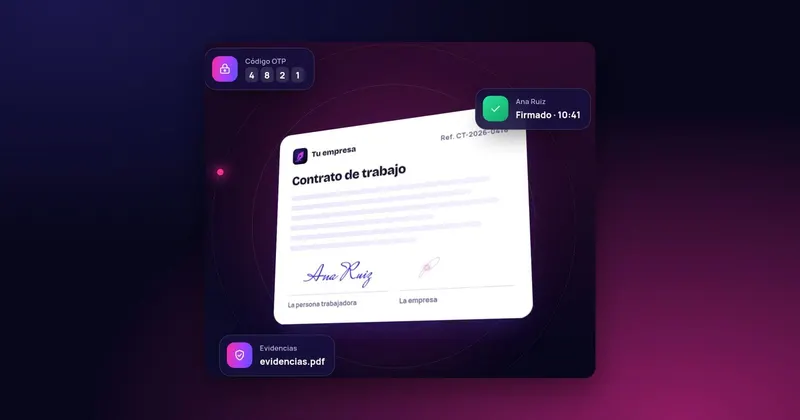
InfoSign isn't only for signing: it also sends certified email notifications with acknowledgement of receipt. They go out from your management software to your employees or customers, with no printing, no stuffing envelopes and no trip to the post office, and you can follow their status in real time and send reminders if they are delayed.
Each notification records when it was sent, when it reached the recipient's mailbox and when they accessed it using their one-time code, and it is stored in the evidence document, just like signatures, with the document's digital fingerprint. It is not a burofax or a qualified electronic registered delivery service: it is proof of dispatch that is worth keeping with the case file, as explained above. You can find all the details in certified notifications and the legal basis in legal validity.

 Test agreement